
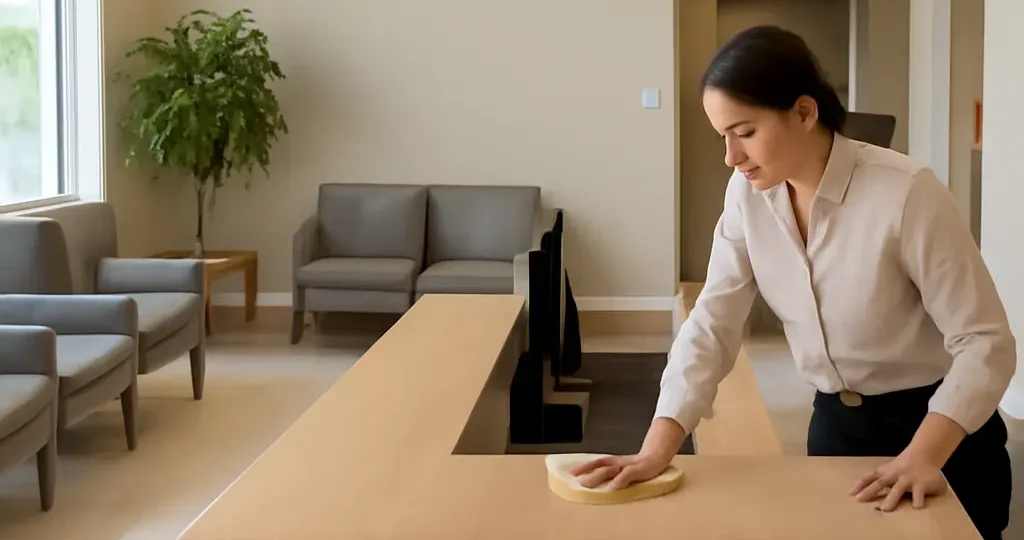

A reception desk is the staffed or self-service point where visitors first seek information, assistance, or access to an organization. Its cleanliness is more than a housekeeping detail: it is a visible signal of care, competence, and attention to safety. Research on first impressions shows that people form judgments quickly, while workplace guidance from the U.S. Centers for Disease Control and Prevention (CDC) emphasizes cleaning frequently touched surfaces. A spotless desk cannot guarantee excellent service, but a visibly dirty one can undermine a welcome sign before anyone says hello. This article explains how reception cleanliness shapes perception, supports hygiene, influences operations, and can be maintained through practical routines.
Reception Desk Cleanliness Shapes First Impressions
Reception desk cleanliness is the visible condition of the desk and its immediate surroundings, including counters, visitor equipment, floors, and shared objects. There is no single universal cleanliness score for reception areas; organizations can instead assess observable conditions such as clutter, dust, spills, waste, and the state of frequently handled items. These cues matter because visitors use what they can see to judge an organization they may not yet know.
A clean desk communicates care and competence
Environmental psychologists have long studied how surroundings influence expectations and behavior. In a classic 1972 experiment, researchers Albert Mehrabian and James Russell examined how environmental qualities such as pleasure and arousal relate to people’s responses to a setting. The study did not measure reception desks specifically, but it supports a relevant principle: the physical environment helps shape how people feel and act. A clear, orderly counter can suggest preparedness; sticky surfaces, overflowing bins, or piles of abandoned paperwork may suggest neglect.
The connection is especially important in settings where trust matters, including clinics, professional offices, hotels, and public-service facilities. Cleanliness is one part of the visitor experience, alongside tone of voice, waiting time, privacy, and signage. It should reinforce good service rather than substitute for it.
First impressions form quickly, but are not a cleanliness statistic
A widely cited 2006 study by Princeton psychologists Janine Willis and Alexander Todorov found that people made judgments about unfamiliar faces after exposures as brief as 100 milliseconds. This research concerns face-based judgments, not reception-area cleanliness, so it should not be treated as proof that visitors judge a desk in exactly the same way. It does, however, illustrate how rapidly people can form initial impressions. In a reception setting, visible conditions may contribute to those early impressions before a visitor has spoken with staff.
Reception Desk Cleanliness Supports Hygiene and Risk Reduction
Hygienic reception desk cleanliness means keeping shared surfaces and equipment in a condition consistent with the organization’s health, safety, and cleaning procedures. It is not the same as sterilization: routine cleaning removes soil and many germs, while disinfection uses products intended to inactivate specified microorganisms. The CDC advises cleaning high-touch surfaces regularly and disinfecting when appropriate, particularly when someone has been ill or when a setting’s risk assessment calls for it.
High-touch points need a risk-based routine
Reception areas often contain shared objects such as pens, payment terminals, door handles, sign-in tablets, counters, and elevator buttons nearby. How often these items should be cleaned depends on use, the type of setting, and applicable public-health or workplace guidance. A clinic receiving patients with contagious symptoms may need more stringent procedures than a small office with low visitor traffic. Staff should follow product labels, surface compatibility instructions, and organizational infection-prevention protocols rather than assume that more chemical use is always safer.
The CDC’s general guidance distinguishes cleaning from disinfecting and recommends paying attention to frequently touched surfaces. This distinction helps prevent two common errors: leaving visible soil in place while applying disinfectant, or using a product in a way that does not meet its label directions.
Cleanability and shared equipment matter
A reception desk is easier to maintain when its design reduces clutter and makes surfaces accessible. Cables, decorative objects, paper stacks, and personal items can obstruct cleaning. Shared touchscreens and payment devices should have cleaning instructions compatible with their materials, and disposable items such as pens should be managed consistently. The U.S. Environmental Protection Agency (EPA) advises users to follow pesticide product labels; for disinfectants, the label specifies where and how the product may be used, including required contact time.
A practical visual aid is a simple “high-touch map” of the reception area, marking counters, handles, devices, and other commonly used surfaces. The map can support a checklist, but the actual schedule should be set by the organization’s risk assessment and relevant sector guidance.
Reception Desk Cleanliness Improves Operations and Accessibility
Operational reception desk cleanliness is the condition that allows staff and visitors to use the area safely and efficiently. An uncluttered counter helps staff find forms and equipment, protects confidential material from casual view, and leaves room for visitors to complete tasks. Cleanliness therefore intersects with organization, privacy, accessibility, and the quality of service.
An orderly counter reduces friction
When supplies have designated locations and obsolete paperwork is removed, staff spend less time searching and visitors face fewer obstacles. The benefit is operational rather than a guaranteed numerical productivity gain: the effect depends on the office, workflow, and consistency of upkeep. A reception team can make the improvement measurable by tracking missed forms, time spent locating materials, or visitor complaints before and after reorganizing the desk.
The desk should also protect privacy. Visitor sign-in sheets, identification documents, appointment lists, and screens may reveal personal information. Keeping only necessary materials in view and positioning displays thoughtfully supports both an orderly appearance and responsible information handling.
Accessibility is part of a welcoming environment
Cleanliness should not be pursued in ways that obstruct access. Bags, bins, cleaning carts, trailing cables, and temporary signs can narrow circulation routes or block a counter. The U.S. Department of Justice’s 2010 ADA Standards for Accessible Design set requirements for accessible routes and service counters in covered facilities. Organizations should assess their reception layout against applicable accessibility requirements, keeping routes clear and ensuring that visitors can reach and use the service point.
A tidy, accessible area is more welcoming than a visually polished counter that leaves some visitors unable to approach or communicate with staff. Where needed, provide clear wayfinding, seating, and an alternative way to request assistance.
Reception Desk Cleanliness Works Best as a Repeatable Practice
Consistent reception desk cleanliness depends on clear ownership, suitable supplies, and routines that fit the real pattern of use. A one-time deep clean may improve appearance temporarily, but a simple shared system is more reliable. The approach should distinguish daily tidying from scheduled surface cleaning and from incident-based response to spills or illness.
Use a short opening, between-visitor, and closing checklist
A practical checklist can specify visible tasks without creating unnecessary paperwork. For example, staff can check that the counter is free of debris, waste is managed, shared items are in their assigned places, spills are addressed promptly, and cleaning supplies are stored safely. High-touch surfaces can be cleaned on the organization’s established schedule, with additional action when conditions or guidance require it.
- At opening: inspect the counter, floor, visitor seating, and shared equipment; remove clutter and report maintenance issues.
- During service: clear abandoned items, respond to spills, and follow the site’s procedure for cleaning shared equipment.
- At closing: reset supplies, dispose of waste appropriately, and record any tasks that need follow-up.
These steps are an operational example, not a substitute for a facility-specific infection-control plan, manufacturer instructions, or applicable regulations.
Measure visible standards and visitor feedback
Managers can evaluate the routine with periodic walk-throughs and a small set of indicators: checklist completion, recurring supply shortages, cleanliness-related complaints, and time taken to resolve reported issues. In healthcare, cleaning programs may use more formal audit methods and environmental-services protocols. In other sectors, a consistent inspection standard can still make expectations clearer without implying that a particular score proves the absence of germs.
Visitor feedback can reveal problems an internal checklist misses, such as an unpleasant odor, confusing sign-in process, or counter height that is difficult to use. Treat feedback as a prompt to investigate and improve rather than as a standalone measure of hygiene.
Conclusion: Let Reception Desk Cleanliness Reinforce the Welcome
Reception desk cleanliness is simultaneously a first-impression cue, a hygiene practice, and an operational standard. Research on environmental perception helps explain why visible surroundings can influence expectations, while CDC and EPA guidance reinforces the need for appropriate, label-compliant care of shared surfaces. Accessibility, privacy, and clear workflows also belong in the definition of a well-maintained reception area.
Organizations can begin by mapping high-touch points, assigning responsibility, creating a brief checklist, and reviewing visitor feedback. Keep the counter clear, follow product and sector guidance, and ensure that cleaning routines never block access. A welcome sign says what an organization hopes to provide; a cared-for reception desk helps make that promise visible.
Sources: Mehrabian, Albert, and James A. Russell, An Approach to Environmental Psychology, MIT Press, 1974; Willis, Janine, and Alexander Todorov, “First Impressions: Making Up Your Mind After a 100-ms Exposure to a Face,” Psychological Science, 2006, https://doi.org/10.1111/j.1467-9280.2006.01750.x; Centers for Disease Control and Prevention, Cleaning and Disinfecting Your Facility, https://www.cdc.gov/hygiene/about/cleaning-and-disinfecting-your-facility.html; U.S. Environmental Protection Agency, Introduction to Pesticide Labels, https://www.epa.gov/pesticide-labels/introduction-pesticide-labels; U.S. Department of Justice, 2010 ADA Standards for Accessible Design, https://www.ada.gov/law-and-regs/design-standards/2010-stds/