
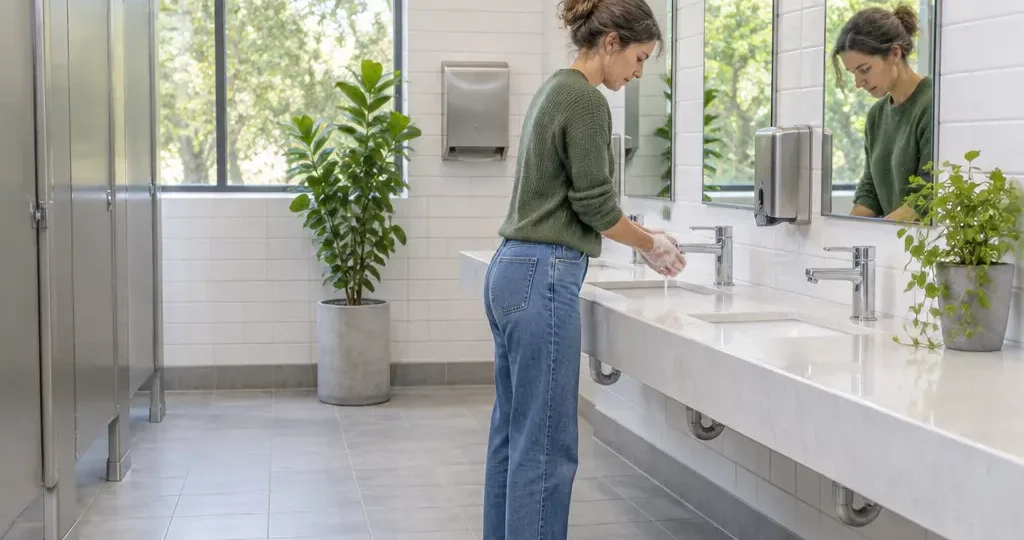

Handwashing is the use of soap and water to remove dirt and microbes from the hands. For routine handwashing, 20 seconds of scrubbing is a useful, evidence-based target—not a magic cutoff: washing for less may remove fewer germs, while thorough coverage and correct technique matter too. The U.S. Centers for Disease Control and Prevention (CDC) recommends scrubbing for at least 20 seconds, and the World Health Organization (WHO) describes a handwashing procedure that takes about 40–60 seconds from start to finish. This guide explains what the 20-second advice means, what research says about timing, how to wash effectively, and when soap and water are especially important.
How the 20-second rule defines effective handwashing
The 20-second recommendation refers to the time spent rubbing hands together with soap, not the entire time at the sink. The CDC’s basic method is to wet hands, apply soap, scrub all hand surfaces for at least 20 seconds, rinse, and dry. The agency suggests humming “Happy Birthday” twice as a timing aid. WHO’s more detailed clinical handwashing technique takes longer overall because it includes multiple steps for covering the hands systematically.
A precise definition helps distinguish the recommended duration from a guarantee of sterility. Soap and friction loosen dirt, oils, and microbes; rinsing carries them away. Handwashing reduces contamination but does not make hands germ-free. How well it works depends on duration, coverage, the presence of soap, and whether hands are dried afterward.
What studies say about washing time
Research supports spending time on the wash, but it does not establish 20 seconds as a universal biological threshold. In a 2012 study published in the International Journal of Environmental Research and Public Health, researchers compared handwashing durations and found that longer washing generally removed more bacteria; washing with soap for 15 seconds reduced bacterial counts more than a short, five-second wash. The study supports avoiding rushed washing, while the CDC’s 20-second advice offers a simple public-health benchmark rather than a promise that every wash removes a fixed percentage of germs.
The evidence also shows why duration is only one part of the process. In a 2017 study in the Journal of Environmental Health, researchers observed 3,749 adults in public restrooms: only 5% washed their hands for at least 15 seconds, and 23% used no soap. These findings illustrate a practical challenge—many people do not wash long enough or use soap consistently—even though both affect cleaning.
Why technique and coverage matter
A complete wash includes the palms, backs of the hands, between the fingers, thumbs, fingertips, and around the nails. A person can spend 20 seconds rubbing only the palms and still miss commonly neglected areas. WHO’s step-by-step method emphasizes rotating and interlacing the fingers and rubbing the fingertips against the opposite palm. These movements make the duration more useful by distributing friction across the skin.
When soap, water, or sanitizer is the right choice
The right hand-cleaning method depends on the kind of contamination and what is available. Soap and water are the preferred choice when hands are visibly dirty or greasy and in certain situations involving germs that alcohol-based sanitizer may not reliably remove. Alcohol-based hand sanitizer is a practical alternative when a sink is unavailable and hands are not visibly soiled.
Situations that call for soap and water
The CDC recommends washing with soap and water before, during, and after preparing food; before eating; after using the toilet; after coughing, sneezing, or blowing the nose; and after caring for someone who is ill. It also advises soap and water when hands are visibly dirty or greasy. Washing is particularly important after possible contact with norovirus, Cryptosporidium, or certain chemical contaminants, because sanitizer may not work as well against some of these hazards.
The wider public-health value is substantial. WHO and UNICEF estimated that in 2022, 2.2 billion people lacked safely managed drinking-water services at home, and 3.4 billion lacked safely managed sanitation. These measures are not identical to access to a handwashing station, but they show why dependable water and sanitation infrastructure remains a global health concern.
Using hand sanitizer when a sink is unavailable
For routine situations when soap and water are not available, the CDC recommends using a sanitizer containing at least 60% alcohol. Apply enough to cover all hand surfaces, then rub until the hands are dry, following the product label. Sanitizer can reduce many kinds of germs, but it does not remove all types, and it may be less effective on visibly dirty or greasy hands. It is also not a substitute for washing after restroom use or when contamination requires soap and water.
A practical 20-second handwashing routine
Use this sequence to turn the time recommendation into a consistent habit. The 20-second count applies to scrubbing with soap; rinsing and drying add time.
- Wet hands with clean running water and apply soap.
- Rub palms together, then scrub the backs of both hands.
- Clean between the fingers, around each thumb, and across fingertips and nails.
- Continue scrubbing for at least 20 seconds; humming “Happy Birthday” twice can help with timing.
- Rinse thoroughly under clean running water and dry with a clean towel or air dryer.
In a workplace or healthcare setting, follow the applicable institutional protocol. WHO’s clinical handwashing sequence is more detailed than the everyday CDC routine and takes approximately 40–60 seconds from beginning to end.
Conclusion: 20 seconds is a useful target, not a magic number
For most everyday handwashing, scrub with soap for at least 20 seconds, cover all hand surfaces, rinse, and dry. Research supports avoiding very short washes, while public-health guidance uses 20 seconds as an easy-to-follow minimum rather than a sharp cutoff. Choose soap and water when hands are visibly dirty or when a particular exposure calls for it; use an alcohol-based sanitizer with at least 60% alcohol when a sink is unavailable and sanitizer is appropriate. Make the routine habitual, and consult CDC and WHO guidance for situations such as food preparation, illness care, or healthcare work.
Sources: U.S. Centers for Disease Control and Prevention, About Handwashing, https://www.cdc.gov/clean-hands/about/index.html; U.S. Centers for Disease Control and Prevention, Hand Sanitizer Guidelines and Recommendations, https://www.cdc.gov/clean-hands/about/hand-sanitizer.html; World Health Organization, How to Handwash? With Soap and Water, https://www.who.int/publications/m/item/how-to-handwash; Burton, M. et al., The Effect of Handwashing with Water or Soap on Bacterial Contamination of Hands, International Journal of Environmental Research and Public Health, 2012, https://doi.org/10.3390/ijerph903097; Borchgrevink, C. P. et al., Hand Washing Practices in a College Town Environment, Journal of Environmental Health, 2017, https://doi.org/10.1080/19338244.2016.1175399; World Health Organization and UNICEF, Progress on Household Drinking Water, Sanitation and Hygiene 2000–2022: Special Focus on Gender, 2023, https://washdata.org/reports/jmp-2023-wash-households.