Blog Post

Cleaning protocols hospitals are quietly upgrading this year

Cleaning protocols hospitals are quietly upgrading this year

Hospital cleaning protocols are the policies and procedures used to reduce contamination on surfaces and equipment in patient-care environments. This year, hospitals are refining them with clearer risk-based rules, stronger attention to high-touch surfaces, improved monitoring, and targeted use of newer technologies—not simply adding more disinfectant. The changes matter: the U.S. Centers for Disease Control and Prevention (CDC) estimates that about 1 in 31 hospital patients has at least one healthcare-associated infection on any given day. Evidence-based cleaning, staff training, and reliable verification remain central to reducing preventable exposure. Risk-based cleaning protocols guide hospital surface care A risk-based cleaning protocol…
Read More
Reception Desk Cleanliness Speaks Louder Than Any Welcome Sign

Reception Desk Cleanliness Speaks Louder Than Any Welcome Sign

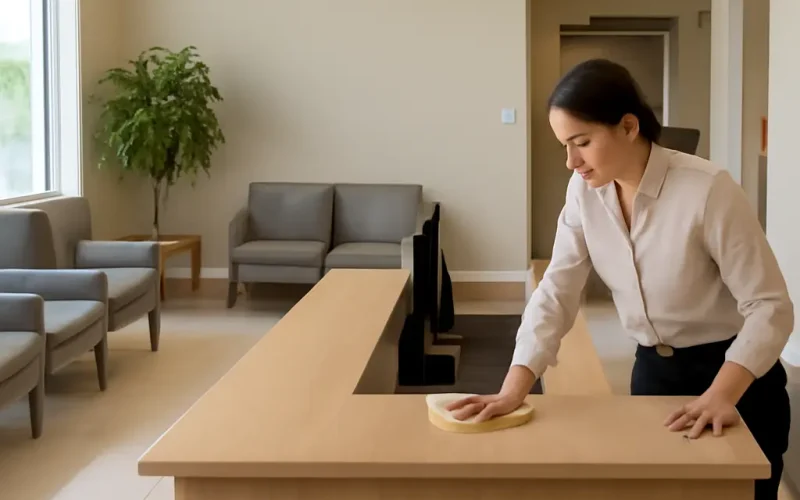
A reception desk is the staffed or self-service point where visitors first seek information, assistance, or access to an organization. Its cleanliness is more than a housekeeping detail: it is a visible signal of care, competence, and attention to safety. Research on first impressions shows that people form judgments quickly, while workplace guidance from the U.S. Centers for Disease Control and Prevention (CDC) emphasizes cleaning frequently touched surfaces. A spotless desk cannot guarantee excellent service, but a visibly dirty one can undermine a welcome sign before anyone says hello. This article explains how reception cleanliness shapes perception, supports hygiene, influences…
Read More
Advanced strategies top hospitals use to sustain infection control gains

Advanced strategies top hospitals use to sustain infection control gains

Infection control gains are not sustained by a single product or campaign; they depend on reliable systems that make safer care routine, detect slippage early, and adapt to new risks. The World Health Organization (WHO) estimates that, in acute-care hospitals, about 7 of every 100 patients in high-income countries and 15 of every 100 in low- and middle-income countries acquire at least one health care-associated infection during their stay. Leading hospitals respond with layered strategies: accountable leadership, practical infection-prevention workflows, data-driven surveillance, antimicrobial stewardship, and a culture in which staff and patients can speak up. Evidence from national programs and…
Read More
Common prep mistakes that quietly increase your infection risk before surgery

Common prep mistakes that quietly increase your infection risk before surgery

Surgical skin preparation mistakes are avoidable actions or misunderstandings before an operation that can leave germs on the skin or interfere with infection-prevention measures. Small choices—such as shaving with a razor, using the wrong cleansing product, or ignoring instructions about medicines—may undermine a carefully planned procedure. The Centers for Disease Control and Prevention (CDC) estimates that about 2.8% of patients undergoing inpatient surgery in U.S. acute-care hospitals develop a surgical site infection (SSI); risk varies by procedure and patient. Follow your surgical team’s instructions rather than trying to “improve” preparation on your own, and contact them if instructions are unclear…
Read More
Common Mistakes Infection Control Teams Make Every Single Day

Common Mistakes Infection Control Teams Make Every Single Day

Infection control teams help prevent infections linked to healthcare, but their effectiveness can be undermined by routine, preventable mistakes: incomplete hand hygiene, inconsistent use of personal protective equipment, weak surveillance, delayed communication, and failure to turn data into action. The Centers for Disease Control and Prevention (CDC) estimates that, on any given day, about one in 31 U.S. hospital patients has at least one healthcare-associated infection (HAI). Avoiding these errors requires more than policies on paper: teams need reliable measurement, clear ownership, practical training, and follow-through with frontline staff. Preventing Errors in Daily Infection Control Practice Infection prevention and control…
Read More
The Hands On Practice That Builds Real Cleaning Skills

The Hands On Practice That Builds Real Cleaning Skills

Hands-on cleaning practice is the repeated, supervised performance of real cleaning tasks—such as dusting, vacuuming, mopping, restroom sanitation, surface disinfection, and safe chemical handling—until a worker can complete them consistently and correctly. This practice builds real cleaning skills because it connects instruction with physical technique, sequencing, judgment, and feedback. The U.S. Bureau of Labor Statistics reports that janitors and building cleaners perform more than 350,000 job openings’ worth of replacement and growth-related work annually, demonstrating the continuing need for workers who can apply practical skills in homes, schools, health-care facilities, offices, and hospitality settings. Effective training therefore combines demonstrations, deliberate…
Read More
Turning Environmental Standards Into Consistent Daily Wins

Turning Environmental Standards Into Consistent Daily Wins

Environmental Standards—Operational Consistency for Turning Daily Actions Into Measurable Wins Environmental standards are documented requirements and performance thresholds used to protect air, water, land, ecosystems, workers, and communities. Turning those standards into consistent daily wins means translating broad commitments into repeatable routines, measurable indicators, accountable ownership, and corrective action. The approach matters because the United Nations Environment Programme reports that global resource extraction has tripled since 1970 and could rise by about 60% from 2020 levels by 2060, while the World Health Organization estimates that 99% of the world’s population breathes air exceeding its guideline limits. Effective environmental management therefore…
Read More
The Feedback Loops That Actually Drive Better Hygiene

The Feedback Loops That Actually Drive Better Hygiene

Hand hygiene feedback loops are recurring systems in which hygiene behavior is observed, measured, communicated, and improved through a subsequent adjustment in practice. The most effective loops combine timely feedback, visible social norms, convenient supplies, reminders, and repeated measurement rather than relying on one-time training. This matters because the Centers for Disease Control and Prevention reports that handwashing can reduce diarrheal illness by 23–40% and respiratory illness by 16–21%, while the World Health Organization estimates that hundreds of millions of patients acquire health-care-associated infections each year. Across hospitals, schools, workplaces, and households, better hygiene results when people can see the…
Read More
Where Most Buildings Fail At Basic Indoor Hygiene

Where Most Buildings Fail At Basic Indoor Hygiene

Buildings—Indoor Hygiene: Where Most Facilities Fail at Basic Indoor Hygiene Building indoor hygiene is the combined condition of a building’s air, moisture, surfaces, water systems, waste controls, and maintenance practices that protect occupants from avoidable biological, chemical, and physical hazards. Most buildings fail not because of one dramatic contamination event, but because routine controls are incomplete: ventilation is inadequate, dampness is left unresolved, filters and drains are neglected, cleaning targets high-touch surfaces inconsistently, and occupants have no clear reporting process. The U.S. Environmental Protection Agency (EPA) notes that people spend approximately 90% of their time indoors and that indoor pollutant…
Read More
Building Reliable Sanitation Into Every Healthcare Shift

Building Reliable Sanitation Into Every Healthcare Shift

Healthcare-shift sanitation reliability is the consistent availability, correct use, monitoring, and rapid restoration of water, hand-hygiene, environmental-cleaning, toilet, laundry, and healthcare-waste services throughout every shift. The World Health Organization (WHO) and UNICEF reported that in 2022 only about 78% of healthcare facilities had basic water services, 57% had basic sanitation services, and approximately 73% had basic hygiene services. Reliable sanitation therefore requires more than a clean facility at opening time: it requires shift-level ownership, stocked supplies, verified cleaning, safe waste flows, and escalation when a control fails. The approach below connects hand hygiene, environmental cleaning, personal protective equipment, waste management,…
Read More