
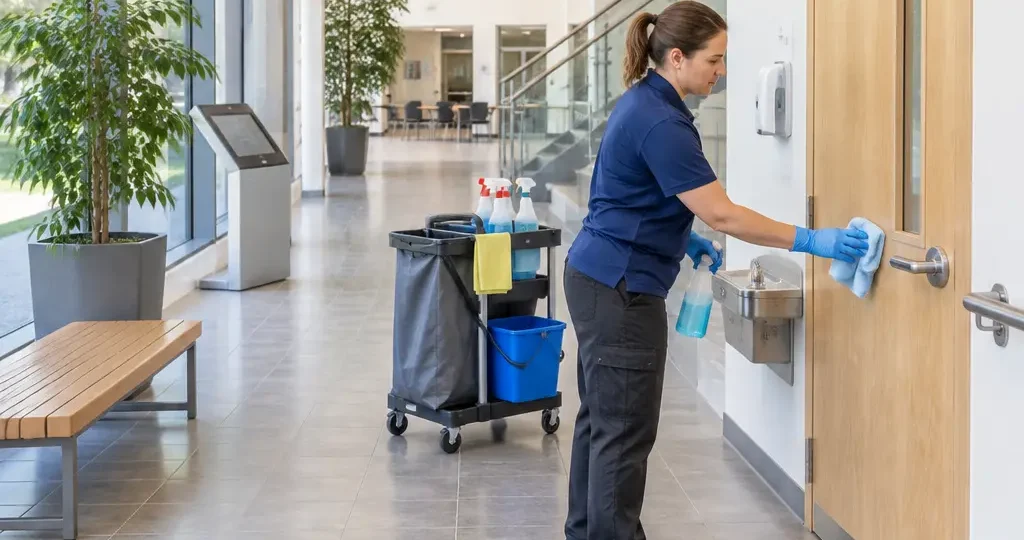

Environmental surface cleaning is the removal of soil and microorganisms from objects and surfaces, with priority given to frequently touched areas rather than to appearance alone. A practical, evidence-informed program identifies high-touch surfaces, cleans them at appropriate intervals, and uses disinfection when required by risk, policy, or public-health guidance. This distinction matters: the Centers for Disease Control and Prevention (CDC) notes that cleaning removes germs and dirt, while disinfecting kills germs on surfaces; routine cleaning is generally sufficient in many community settings, but targeted disinfection can be warranted. The sections below explain how to prioritize surfaces, choose methods, verify performance, and apply the approach in real settings.
Prioritizing environmental surface cleaning by touch frequency and risk
High-touch-zone prioritization is a cleaning strategy that ranks surfaces by how often people contact them, how likely they are to become contaminated, and the consequences of exposure. The CDC describes high-touch surfaces in healthcare environments as surfaces that are frequently handled, including bedrails, light switches, and doorknobs. This risk-based definition shifts the goal from making every surface look equally polished to reducing contamination where contact and transmission opportunities are greatest.
The approach is not a reason to ignore visible soil or other areas. It is a way to allocate staff time, cleaning frequency, and inspection effort according to potential exposure. Related categories include high-touch and low-touch surfaces, routine and terminal cleaning, cleaning and disinfection, and risk-based prioritization. The precise schedule depends on the setting, population, product instructions, and applicable public-health or regulatory requirements.
High-touch surfaces: contact frequency as a practical risk indicator
A high-touch surface is an object or area that many people handle or that an individual repeatedly touches during normal use. Examples include door handles, elevator buttons, faucet handles, shared keyboards, handrails, desks, and frequently used control panels. Touch frequency is useful for deciding where to focus, but it is not a direct measurement of infection risk: risk also depends on whether a pathogen is present, how long it remains viable, how it transfers, and whether people touch their eyes, nose, or mouth afterward.
Healthcare guidance commonly distinguishes high-touch surfaces from low-touch surfaces such as walls and ceilings, which are typically cleaned less often unless visibly soiled or otherwise indicated. A facility can identify its priority zones by observing how spaces are used, consulting cleaning staff, and reviewing the surfaces most frequently handled by occupants. The CDC’s environmental infection-control guidance emphasizes selecting cleaning frequency according to the surface, the amount of activity, and the risk of contamination.
Cleaning versus disinfection: appearance is not the endpoint
Cleaning uses water, detergent, and physical action to remove soil and many germs from surfaces; disinfection uses an appropriate chemical product to inactivate microorganisms that remain. Cleaning should generally precede disinfection when a surface is soiled, because organic material can interfere with disinfectant performance. The U.S. Environmental Protection Agency (EPA) also advises users to follow a registered product’s label, including its approved uses and required wet contact time.
A shiny surface is not proof that it has been adequately cleaned or disinfected. Conversely, a surface can be hygienically acceptable without looking newly polished. In community settings, the CDC says routine cleaning with soap or detergent is generally enough to reduce germs on surfaces; disinfection is especially relevant when someone is sick, when a setting has specific infection-control requirements, or when public-health guidance calls for it.
Applying high-touch-zone cleaning across settings
Once a facility has identified priority surfaces, the next step is to match the method and schedule to the setting. The same object can carry different levels of practical concern in different environments: a shared desk in a classroom, a bedside table in a hospital, and a checkout counter in a shop have different users, cleaning constraints, and consequences of contamination. A useful plan therefore combines surface classification with occupancy, use patterns, and the relevant infection-prevention standards.
Healthcare and long-term care: cleaning within infection-prevention protocols
In healthcare, environmental cleaning is part of a broader infection-prevention system, not a substitute for hand hygiene, ventilation, appropriate protective equipment, or clinical precautions. The CDC’s healthcare guidance calls for more frequent attention to high-touch surfaces and specifies that cleaning practices should reflect the risk of the care area and the patient population. Bedrails, call buttons, bedside tables, bathroom fixtures, and shared equipment are typical priority items, subject to facility policy and product compatibility.
For patient-care areas, staff should follow established procedures for routine cleaning and for cleaning after discharge or transfer. The Environmental Cleaning Procedures guidance developed by the CDC and the Infection Control Africa Network describes structured approaches to cleaning frequency, methods, and monitoring. Facilities should use their own validated protocols and applicable regulations rather than treating a general checklist as a replacement for clinical infection-control guidance.
Schools, offices, and public spaces: prioritize shared contact points
In schools, offices, transit facilities, and retail environments, priority zones often include entrance hardware, shared workstations, restroom fixtures, cafeteria tables, handrails, and equipment used by multiple people. The CDC’s guidance for community settings recommends regular cleaning of frequently touched surfaces and notes that routine cleaning is generally adequate when there is no special contamination event. More intensive disinfection may be appropriate when a person is ill or when a specific public-health recommendation applies.
Scheduling should reflect actual use rather than a uniform calendar alone. A school might clean shared classroom materials between groups, while a busy office may give extra attention to shared kitchen handles and conference-room controls. A simple site map or checklist can record priority zones, responsible staff, cleaning frequency, and exceptions such as visible spills or outbreak-related instructions.
Cleaning frequency and prioritization: a risk-based schedule
A risk-based schedule sets the frequency of cleaning according to how often a surface is touched, how many people share it, whether it is likely to receive bodily fluids or food residue, and the vulnerability of people using the area. It should also account for surface material and manufacturer instructions, because some chemicals can damage electronics, coatings, or other finishes. A high-touch list is a prioritization tool, not a fixed universal timetable.
The CDC’s community guidance advises cleaning high-touch surfaces regularly and cleaning more often when a space is used by many people or when it is visibly dirty. In healthcare, schedules are more specific and depend on the care environment and infection-control policy. Facilities can make the schedule actionable by recording who cleans each zone, which product is approved, how long the surface must remain wet when disinfecting, and how completion is checked.
Measuring cleaning quality beyond visual appearance
Visual inspection can identify visible soil, but it cannot reliably establish whether microorganisms have been removed or inactivated. A stronger quality-assurance program combines clear procedures, staff training, direct observation, and proportionate monitoring. This makes performance measurable without confusing cosmetic standards—such as shine or uniform appearance—with hygienic outcomes.
Checklists and direct observation: confirming the work was completed
A cleaning checklist documents whether designated surfaces were addressed, while direct observation can reveal missed areas, ineffective technique, or workflow barriers. Checklists are most useful when they name specific objects rather than broad categories such as “clean room.” For example, a restroom checklist can separately identify faucet handles, flush controls, door hardware, and dispensers.
The CDC’s healthcare environmental-cleaning resources describe monitoring approaches that can support quality improvement. Results should be used to identify training needs and process weaknesses, not merely to penalize individual workers. Facilities should also make the checklist feasible to complete during the time and staffing available.
Fluorescent markers and ATP testing: useful tools with limits
Fluorescent markers can be placed on selected surfaces before cleaning and checked afterward to see whether the marked area was wiped. Adenosine triphosphate (ATP) tests detect biological material left on a surface and can provide rapid feedback about cleaning performance. These tools measure different things: a marker assesses whether a location was physically wiped, while ATP is an indicator of residual biological material, not a direct count of infectious pathogens.
A 2010 study by Carling and colleagues in the journal Infection Control & Hospital Epidemiology found that only about 47% of targeted objects in participating acute-care hospitals were cleaned effectively before an intervention. The study illustrates why observation and feedback can uncover missed surfaces that a room’s overall appearance may conceal. Its result should be understood in context: it reflects the hospitals and methods studied, not a universal rate for every facility.
Operational safeguards for safer, more consistent cleaning
A priority-based program succeeds only when its instructions are safe, repeatable, and compatible with the space. Staff need clear product guidance, access to supplies, and enough time to complete high-priority tasks. The following safeguards connect surface selection with consistent execution.
Product selection, contact time, and surface compatibility
Use a cleaning or disinfecting product appropriate for the surface and the intended task. When disinfection is required, follow the product label for the organisms covered, dilution, ventilation, protective equipment, and wet contact time. EPA-registered disinfectants are evaluated for specified uses; registration does not mean that every product is suitable for every surface or situation.
Do not mix cleaning chemicals, and avoid applying products to electronics or delicate finishes unless the manufacturer permits it. Staff should be trained to distinguish routine detergent cleaning from disinfection and to handle reusable cloths, mop heads, and solutions according to facility procedures. These steps reduce both missed work and avoidable chemical exposure or property damage.
Staff training, workflow, and equitable standards
Training should demonstrate the correct wiping sequence, use of fresh cloth surfaces, prevention of cross-contamination, and the difference between cleaning and disinfecting. Workflows should make high-touch items easy to find and should give cleaners clear authority to report damaged surfaces, unavailable products, or unrealistic time allocations. The CDC and the World Health Organization both treat environmental cleaning as a defined component of infection prevention that depends on trained personnel and appropriate systems.
A fair performance standard evaluates whether priority surfaces were treated effectively and safely, rather than judging workers solely by visual polish. That distinction also supports better resource allocation: facilities can direct attention to high-contact points and visibly soiled areas while avoiding unnecessary chemical use on low-risk surfaces. Cleaners should be included in planning because they understand the practical conditions of the work.
Conclusion: prioritize contact, verify practice, and use appearance appropriately
Environmental surface cleaning should prioritize high-touch zones because repeated contact creates practical opportunities for contamination and transfer. Effective programs distinguish cleaning from disinfection, tailor schedules to setting and risk, and measure completion with checklists, observation, or monitoring tools rather than relying on appearance alone. Evidence from healthcare monitoring studies shows that frequently used surfaces can be missed even when a room looks clean, while public-health guidance supports routine cleaning and targeted disinfection when circumstances warrant it.
Organizations can act by mapping high-touch surfaces, setting clear and realistic schedules, training staff on products and technique, and reviewing results to improve the process. For further guidance, consult current CDC environmental-cleaning recommendations, EPA disinfectant-label instructions, and applicable local requirements. A visually tidy space is valuable, but the priority should be a safe, well-maintained environment where the surfaces people touch most receive appropriate attention.
Sources: Centers for Disease Control and Prevention, Cleaning and Disinfecting Your Facility, https://www.cdc.gov/hygiene/about/when-and-how-to-clean-and-disinfect-your-home.html; Centers for Disease Control and Prevention, Guidelines for Environmental Infection Control in Health-Care Facilities, https://www.cdc.gov/infection-control/hcp/environmental-control/guidelines-environmental-control.html; Centers for Disease Control and Prevention and Infection Control Africa Network, Best Practices for Environmental Cleaning in Healthcare Facilities in Resource-Limited Settings, https://www.cdc.gov/healthcare-associated-infections/hcp/cleaning-global/index.html; U.S. Environmental Protection Agency, About List N: Disinfectants for Coronavirus (COVID-19), https://www.epa.gov/coronavirus/about-list-n-disinfectants-coronavirus-covid-19; Carling, P. C., Parry, M. F., Rupp, M. E., Po, J. L., Dick, B., and Von Beir, V., Improving Cleaning of the Environment Surrounding Patients in 36 Acute Care Hospitals, Infection Control & Hospital Epidemiology, 2010, https://doi.org/10.1086/649228; World Health Organization, Environmental Cleaning and Infection Prevention and Control in Health Care Facilities, https://www.who.int/publications/i/item/9789240051065.