
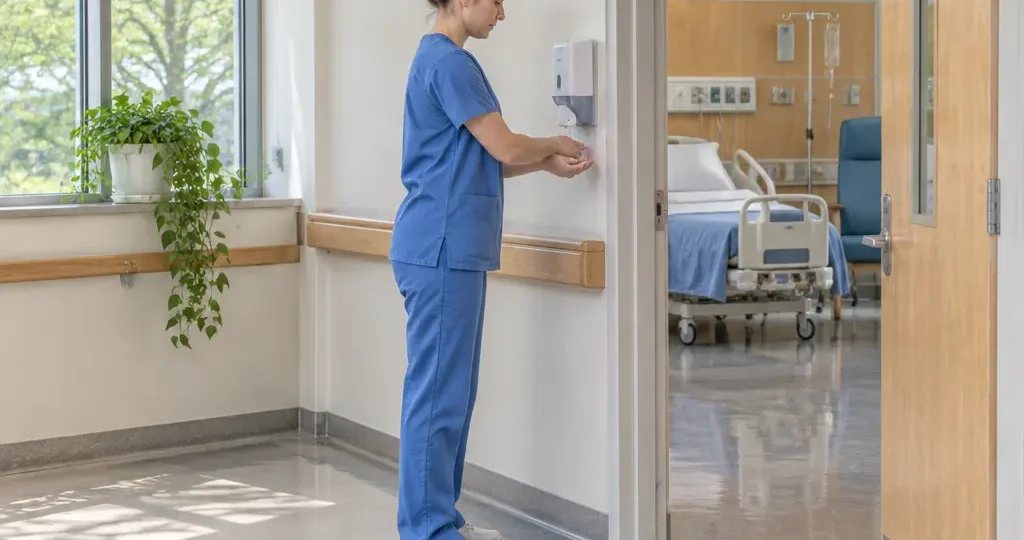

Hand hygiene compliance is the extent to which healthcare workers clean their hands at the moments required to reduce transmission of infectious organisms. Embedding it into workflow design means making the safe action timely, accessible, and easy to complete—not relying on policy, reminders, or individual memory alone. The World Health Organization (WHO) identifies hand hygiene as a core infection-prevention measure, while the U.S. Centers for Disease Control and Prevention (CDC) recommends alcohol-based hand sanitizer as the preferred method in most clinical situations when hands are not visibly soiled. Effective programs therefore combine point-of-care supplies, care-process design, training, measurement, and feedback. The need is substantial: the WHO estimates that, in acute-care hospitals, about 7 out of every 100 patients in high-income countries and 15 out of every 100 in low- and middle-income countries acquire at least one health care-associated infection during their hospital stay.
Workflow Design for Hand Hygiene Compliance
Workflow design is the deliberate arrangement of people, tasks, spaces, tools, and information so that essential work can be completed reliably. Applied to hand hygiene, it treats each opportunity to clean hands as part of the care sequence—for example, before touching a patient, before a clean or aseptic procedure, after body-fluid exposure risk, after touching a patient, and after touching the patient’s surroundings. WHO calls these the “Five Moments for Hand Hygiene.” Compliance is thus not simply a matter of knowing the rules; it depends on whether the right product is available at the right place and moment, and whether the workflow supports its use.
This approach recognizes several related forms of workflow intervention: point-of-care product placement, task and room sequencing, environmental and equipment design, staffing and workload planning, and measurement with feedback. These interventions address barriers such as distant sinks, empty dispensers, interruptions, unclear responsibilities, and competing time demands. They also help organizations distinguish a knowledge problem from a system problem before choosing a solution.
Point-of-care access and environmental design
Point-of-care access means placing alcohol-based hand rub where care is delivered, such as on a patient-room wall, at the bedside, or on a healthcare worker’s belt. CDC guidance prefers alcohol-based hand sanitizer in most clinical situations because it is effective, can be used rapidly, and is less likely than repeated soap-and-water washing to irritate skin. Soap and water remain important when hands are visibly soiled and in other situations specified by infection-control guidance.
Environmental design should make dispensers visible, reachable, functional, and compatible with safe movement through the care space. In a 2014 systematic review and meta-analysis, Luangasanatip and colleagues found that WHO-recommended multimodal hand-hygiene strategies improved compliance; interventions that included system change, such as reliable product access, formed part of this evidence base. The practical implication is to audit actual care locations—not just corridors—and check dispenser placement, refill schedules, accessibility, and compatibility with clinical equipment and mobility needs.
Task sequencing and the Five Moments
Task sequencing arranges care so hand hygiene occurs at meaningful transitions rather than being treated as a separate, easily forgotten task. For example, a clinician preparing a clean procedure can gather supplies first, perform hand hygiene immediately before the aseptic task, and avoid touching contaminated surfaces afterward. The WHO Five Moments provide a shared map for these transitions and help teams identify where a workflow creates ambiguity or unnecessary movement.
A useful redesign examines the sequence of patient contact, equipment use, documentation, and room exit. If staff repeatedly move between clean and contaminated tasks, the organization can clarify task order, locate supplies at transition points, and define when gloves must be changed and hand hygiene performed. Gloves do not replace hand hygiene: CDC guidance calls for hand hygiene before donning gloves when indicated and after glove removal.
Measurement and Feedback for Hand Hygiene Compliance
Measurement turns workflow intentions into observable performance. Compliance is commonly calculated as the number of hand-hygiene actions performed divided by the number of observed opportunities, multiplied by 100. However, the result depends on how opportunities are defined, which units and shifts are sampled, and how observation is conducted. A single hospital-wide percentage can conceal differences by role, location, or moment of care, so measurement should be designed to guide improvement rather than merely rank teams.
Direct observation and electronic monitoring
Direct observation allows trained observers to assess whether hand hygiene occurred at specific care moments and can reveal workflow barriers that dispenser counts cannot explain. Its limitations include observer workload and the possibility that staff alter behavior when they know they are being watched. Electronic monitoring can provide broader or more continuous data, but systems may not reliably identify every patient-care opportunity or distinguish appropriate from inappropriate dispenser use. The WHO’s hand-hygiene monitoring framework and CDC materials emphasize using measurement methods thoughtfully and interpreting results in context.
Organizations should define the measure before collecting data, train observers consistently, and avoid treating different methods as interchangeable. Combining observation with product-use data, dispenser-function checks, staff feedback, and infection-prevention indicators can provide a more complete picture. No single metric establishes that a workflow is safe or that a hand-hygiene intervention caused a change in infection rates.
Feedback, goals, and accountability
Feedback is the timely communication of performance information to the people who can act on it. Useful feedback is specific, non-punitive, and connected to a practical next step—for instance, reporting that a dispenser is inaccessible during a particular procedure and assigning a team to relocate it. WHO’s multimodal strategy combines system change with training, evaluation and feedback, workplace reminders, and an institutional safety climate. This makes accountability a shared leadership and design responsibility, not simply an individual compliance score.
Teams can review trends by unit, shift, profession, and WHO moment, then test focused changes using small improvement cycles. Targets should be realistic and paired with checks for unintended effects, such as excessive workload, skin irritation, or dispensing equipment that obstructs care. Sharing results with frontline staff closes the loop between measurement and redesign.
Implementation Through a Multimodal Infection-Control Program
A multimodal program combines complementary interventions because individual reminders rarely overcome every operational barrier. The WHO strategy includes five components: system change; training and education; evaluation and feedback; workplace reminders; and an institutional safety climate. In the 2014 meta-analysis by Luangasanatip and colleagues, the WHO-5 strategy and related interventions were associated with improved hand-hygiene compliance across studies, although results varied by setting and intervention. The evidence supports coordinated action rather than assuming one poster, campaign, or technology will solve the problem.
Leadership, staffing, and safety climate
Safety climate is the shared understanding that infection prevention is a priority supported by leaders, staffing decisions, resources, and everyday team behavior. Leaders shape that climate by ensuring supplies are funded and maintained, protecting time for training, and responding to staff reports about barriers. Workload matters: when staffing or task design makes essential pauses difficult, exhortations to “be more careful” are unlikely to produce reliable improvement.
A practical governance structure assigns responsibility for dispenser maintenance, product selection, training, observation, and feedback. It also includes frontline workers in redesign, since nurses, physicians, technicians, environmental-services staff, and others encounter different hand-hygiene opportunities and constraints. This shared ownership connects policy to the real conditions of care.
Training, reminders, and skin health
Training defines when and how to perform hand hygiene, while reminders make the expected action easier to recall at the point of work. Effective education uses role-specific examples and demonstrations rather than policy distribution alone. Skin health also affects adherence: frequent hand cleaning can cause irritation for some workers, so facilities should select suitable products, provide compatible moisturizers, and explain that alcohol-based hand rub is generally less irritating than repeated soap-and-water washing when its use is appropriate.
The CDC recommends following product instructions and local infection-control guidance, including using soap and water when hands are visibly dirty or greasy. Training should also clarify glove use, hand hygiene around aseptic procedures, and circumstances that require soap and water. These details prevent a simplified message from creating unsafe substitutions or confusion.
A practical workflow redesign cycle
A structured redesign cycle helps teams move from general concern to tested operational change. Start by observing care and asking staff where hand hygiene is difficult; map the patient-care sequence and locate missed or awkward opportunities; identify whether the barrier involves access, equipment, knowledge, workload, or norms; then test a targeted change and measure its effect. Review both compliance and staff experience, adjust the design, and sustain successful changes through routine maintenance and onboarding.
- Map care tasks against the WHO Five Moments in representative settings and shifts.
- Check dispenser location, function, refill reliability, and product suitability at the point of care.
- Ask frontline teams to identify interruptions, unnecessary movement, and unclear task transitions.
- Test a focused change, such as relocating a dispenser or revising task order, and measure consistently.
- Share findings, address unintended consequences, and incorporate effective changes into standard work.
Real-World Relevance and Continuing Challenges
The WHO’s global estimates underline why dependable workflow matters: health care-associated infections affect patients across income settings, with estimated inpatient occurrence higher in low- and middle-income countries than in high-income countries. Those figures describe the burden of infection, not the share that can be prevented by hand hygiene alone. Infection risk also depends on factors such as device use, environmental cleaning, antimicrobial resistance, and the patient’s condition; hand hygiene is one essential element of a broader prevention system.
A practical example is a hospital unit that finds missed hand-hygiene opportunities during transitions between patient contact and equipment handling. Rather than responding only with a reminder campaign, the unit can observe the sequence, place hand rub at the transition point, clarify equipment-cleaning responsibilities, and provide feedback by care moment. The intervention is then assessed through repeated observation and staff feedback. This illustrates the core principle: improve the conditions surrounding the behavior, not just the wording of the policy.
Figure suggestion: a workflow map showing patient-care tasks alongside the WHO Five Moments, with hand-rub locations marked at transition points. A complementary chart could compare observed compliance by unit and hand-hygiene moment over time, while clearly identifying the observation method and sample size.
Conclusion: Make Hand Hygiene the Easy, Expected Action
Workflow design embeds hand hygiene by aligning point-of-care access, task sequencing, environmental conditions, measurement, feedback, and organizational support. The WHO Five Moments identify when action is needed; multimodal programs help ensure the tools, skills, and safety climate are in place; and careful measurement shows where redesign is most useful. With health care-associated infections remaining a substantial global concern, organizations should assess real work conditions, involve frontline staff, and test improvements rather than relying on policy alone. Leaders and infection-prevention teams can begin by mapping one high-risk care process, checking product access at every transition, and reviewing results with the people who perform the work.
Sources: World Health Organization, Global report on infection prevention and control, 2022, https://www.who.int/publications/i/item/9789240051164; World Health Organization, WHO Guidelines on Hand Hygiene in Health Care, 2009, https://www.who.int/publications/i/item/9789241597906; World Health Organization, WHO Guidelines on Hand Hygiene in Health Care: First Global Patient Safety Challenge—Clean Care Is Safer Care, https://www.who.int/teams/integrated-health-services/infection-prevention-control/hand-hygiene; Centers for Disease Control and Prevention, Clinical Safety: Hand Hygiene for Healthcare Workers, https://www.cdc.gov/clean-hands/hcp/clinical-safety/index.html; Luangasanatip, N. et al., “Comparative efficacy of interventions to promote hand hygiene in hospital: systematic review and network meta-analysis,” BMJ, 2015, https://www.bmj.com/content/351/bmj.h3728